Stay compliant.
Keep earning.
APCA manages DOT-mandated drug and alcohol testing programs for FMCSA and USCG employers — from consortium enrollment and random selections to recordkeeping and audit support.
What is DOT drug and alcohol testing?
The U.S. Department of Transportation (DOT) requires drug and alcohol testing for employees in safety-sensitive transportation jobs. Federal law — not company policy — mandates these programs. Employers who fail to maintain a compliant program face civil penalties, out-of-service orders, and loss of operating authority.
DOT drug testing uses a standardized 5-panel urine test that screens for five substance categories: marijuana (THC), cocaine, amphetamines (including methamphetamine and MDMA), opioids (including heroin, morphine, codeine, hydrocodone, and oxycodone), and phencyclidine (PCP). The test panels, cutoff levels, and laboratory procedures are set by DOT — employers cannot modify or substitute them.
All DOT drug and alcohol testing procedures — regardless of which DOT agency regulates you — are governed by 49 CFR Part 40. Each agency (FMCSA, USCG, FAA, FRA, etc.) then adds its own regulation specifying who must test, when, and at what rates.
DOT 5-Panel Drug Test — Substance Classes
Cutoff levels set by 49 CFR Part 40 and SAMHSA. Confirmation testing uses GC/MS or LC/MS/MS. All results reviewed by a certified Medical Review Officer (MRO).
Full 5-panel breakdownFMCSA & USCG — know your CFRs
Both programs follow the same 49 CFR Part 40 testing procedures, but each agency adds its own layer of requirements. Here's exactly what applies to you.
FMCSA Testing Program
Governing regulations
Establishes who must be tested, when testing is required, and the consequences of violations for CDL drivers operating commercial motor vehicles (CMVs) in interstate commerce.
Governs the actual collection, laboratory analysis, MRO review, and reporting procedures for all DOT agency drug and alcohol tests — including FMCSA-regulated employers.
Who must comply
- CDL drivers operating CMVs in interstate commerce
- Owner-operators (must join a consortium)
- Motor carriers employing CDL drivers
- Drivers performing safety-sensitive functions
Non-compliance penalties
Civil penalties under 49 U.S.C. § 521(b)(2)(B)
Driver removed from safety-sensitive duties pending resolution
FMCSA can suspend or revoke a carrier's operating authority
Drivers with unresolved violations are prohibited from operating CMVs
drug testing rate
alcohol testing rate
49 CFR Part 40 applies to both programs
Regardless of whether your employees are regulated by FMCSA or USCG, the collection, laboratory, MRO, and reporting procedures are identical — governed by 49 CFR Part 40. APCA uses only DOT-qualified collection sites, SAMHSA-certified laboratories, and certified Medical Review Officers.
The six DOT-required test occasions
DOT regulations specify exactly when you must test. Missing any of these occasions — or testing outside the required windows — creates a compliance violation.
Pre-Employment
Required before a covered employee first performs any safety-sensitive function. A verified negative result must be received before the employee begins work. For FMCSA, a Clearinghouse query is also required.
Random Testing
Unannounced selections made at random throughout the year. FMCSA requires 50% drug / 10% alcohol of the average driver count annually. USCG requires 50% drug / 25% alcohol. Employees must be tested immediately upon notification.
Post-Accident
Required after certain qualifying accidents. For FMCSA: fatal accidents always trigger testing; injury or tow-away accidents trigger testing unless the driver's behavior can be discounted. Testing must occur within 8 hours (alcohol) and 32 hours (drugs) of the accident.
Reasonable Suspicion
Ordered when a trained supervisor observes specific, contemporaneous, articulable behavioral or physical signs consistent with drug or alcohol use. The supervisor observation must be documented in writing.
Return-to-Duty
Required before an employee who violated the program may return to safety-sensitive duties. Must follow a substance abuse professional (SAP) evaluation and recommended treatment or education.
Follow-Up
Unannounced testing after return-to-duty, as directed by the SAP. Minimum 6 tests in the first 12 months; the SAP may extend follow-up testing for up to 5 years.
Ready to set up your DOT testing program?
We'll handle enrollment, random selections, and recordkeeping — start to finish.
Your compliance command center.
The APCA employer portal gives you real-time visibility into your entire testing program. Track every employee's status, view results as they come in, and access audit-ready records — all in one place.
- Employee roster with real-time compliance status
- Random selection notifications and completion tracking
- Fast test result delivery
- Audit-ready records, always organized
- Secure role-based access for HR teams
- Mobile-friendly for on-the-go access
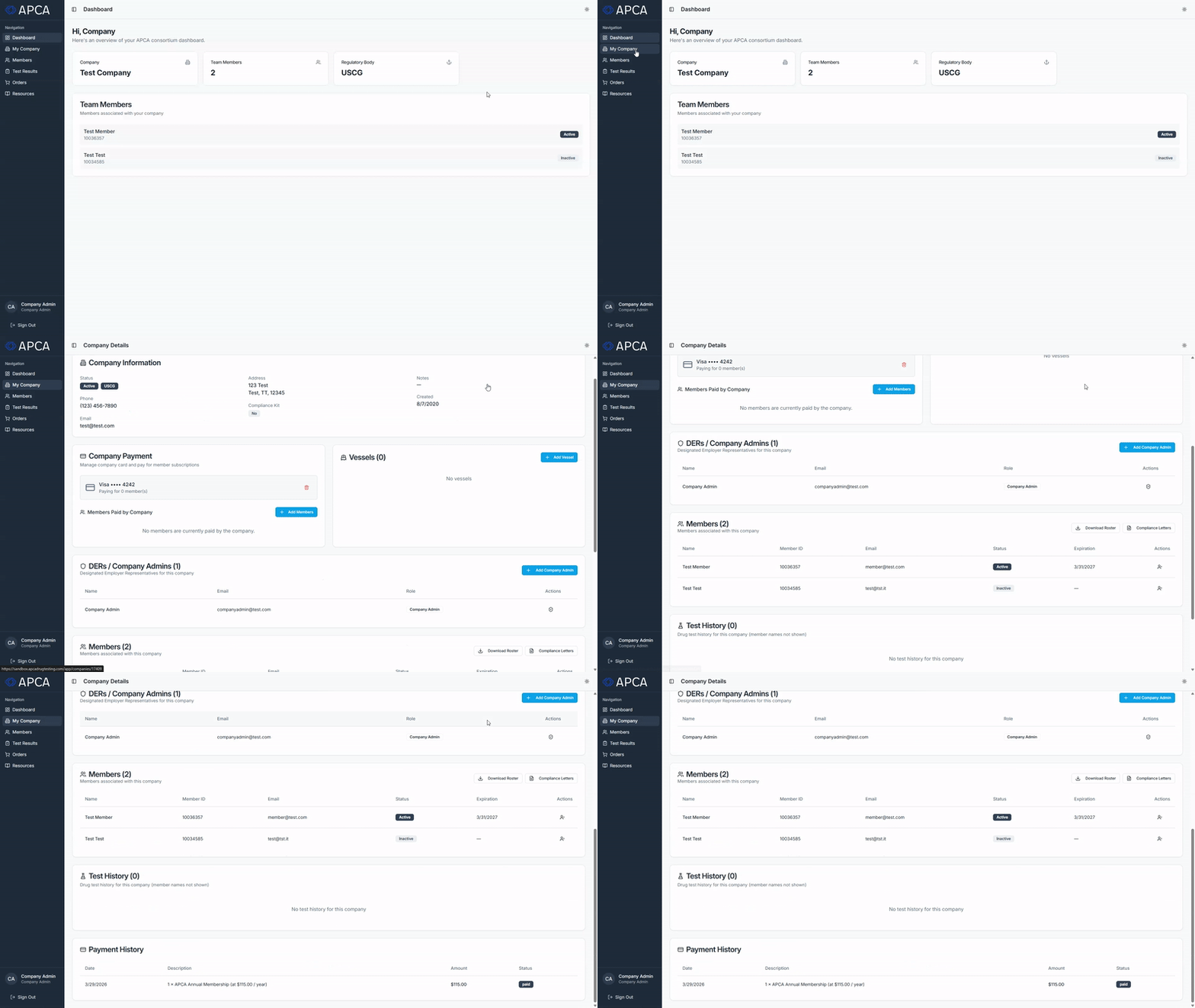
What's included in your program
Everything you need to run a compliant DOT drug and alcohol testing program — managed entirely by APCA.
Employee Enrollment Management
We handle all employee enrollment — from initial setup to ongoing additions and terminations. Your roster stays current without any manual work.
Random Selection Administration
Scientifically valid random selections that meet federal rate requirements. We notify you of selected employees and track completion to keep your program audit-ready.
Results & Recordkeeping
All test results are stored securely in your portal. Audit-ready records, organized and accessible whenever you need them — for as long as federal regulations require.
Compliance Alerts
Automated alerts for upcoming random selection deadlines, employees due for testing, and any compliance issues that need immediate attention.
Audit Preparation
When a DOT audit comes, we're ready. All documentation is organized, complete, and available for immediate review by inspectors.
Dedicated Support
A real compliance specialist answers your calls. Not a chatbot, not a voicemail — a person who knows your program and can answer DOT questions on the spot.
When things go wrong.
Compliance issues happen. What matters is how quickly and correctly you respond. APCA provides expert guidance when you need it most.
Positive Test Result
We guide you through the required steps — removing the employee from safety-sensitive duties immediately, SAP referral, Clearinghouse reporting (FMCSA), and documentation — so you handle it correctly the first time.
DOT Audit Notice
Don't panic. APCA has all your records organized and ready. We'll help you prepare your documentation and respond to the audit with confidence.
Post-Accident Testing
We provide support for post-accident testing situations. We'll locate the nearest qualified collection site and walk you through the time-sensitive DOT requirements step by step.
Start your DOT testing program today.
Set up takes minutes. We handle enrollment, random selections, results, recordkeeping, and audit support — so you can focus on running your operation.